Whatever the project, from concept to finish: my work is led by the nuances of visual communication. There is an ART to the alchemy of design and what it says about your brand or business.
Creative VISION, Technical Thinking.
Structure always comes first in my work as the foundation of visual storytelling. In both art & design: every element placement, proportion, interval, contrast, angle, and visual weight all coordinate like an orchestrated symphony to harmonize, leading the observer through the world and subject.
Inside a team
Visual Designer, EditButter Studios, 2025–2026. Contract role designing social content inside a working studio team. Client work under NDA; role level only.
Invited and juried
Guest artist presenter for L’Oréal Professionnel at ASA ’24, one of three invited presenters. HUG First Class, 100 Artists to Watch, 2024. Two-person exhibition, Sawtelle Gallery, Los Angeles, 2026.
My own practice
Kaeli VanFossen Creative, 2020 to present. Client design work, art commissions, and digital products with published pricing, run as a working business.
I concept the plan, direct the project, audit and debate the drafts, and decide what ships.
Tools churn, so my kit is a system, not a list.
Thinking and builds
 Muse
 ChatGPT (Astra)
 Claude
 Grok
Visual assets
 Midjourney
Design and editing
 Adobe AI features
 Canva AI features
Design and build
 Figma
The problem and its audience come first: references, plan, parameters, and guardrails are set before any prompt.
Each draft gets audited against the brief and the spec.
Kept, corrected, or sent back. Nothing ships unaudited.
Anything that misses the bar gets cut.
Sunk work is not a defense. If it drags down the quality or performance of the piece, I table it or trash it.
Project Pipeline
The pipeline graph behind every project I run, design, art, research, or build.
My judgmentAgent workEvidence and checks
Loops back until it passes.
Every project ships with a machine-readable context file.
I specialize in the craft of converting information into visuals across pixels, paint, and code.
The Refusals
The finished holographic card, and every version I refused on the way to it. Each failed on something you can measure: the wrong shine, the wrong color, a foil that lagged, blurred, or went soft at a held tilt.

Try it on your phone
Scan to open this page on your phone. The holographic foil responds to your phone's tilt.


Selected Work
Brand Atmosphere Concept: Mocha Browns
Created for L'Oréal Professionnel's DiaColor launch and presented on stage at ASA '24, one of three artists selected for the collaboration.


Social Covers and Carousels: Dental Practice
Designed at EditButter Studios. Client name withheld under NDA.


Interior Composite Generated Mockup for Lazy Seasons '26
I composited my painting into a generated room; every furnishing is a real product, sourced and credited. My correction notes directed the room's final form.


Brand Identity Exploration: Rio Art Residency
Paid commission, delivered in full. The residency's final identity was developed in-house by its curator, Efdot.


On-Brand Social Content System
Template systems, course campaigns, and event graphics for Travis Parker's Hairdressing Made Easy, built at EditButter Studios and shared with his permission.


 Muse Canvas
, the pan-and-zoom canvas I built for Meta Muse, is on Gumroad: gumroad.com/l/musecanvas
TESSERAE
ODDMENTS
A contemporary digital art collection of playable puzzles
Spec, design, artwork · HTML + JavaScript · Nov 2026
For playability, my spec deals the shuffle as 160 random valid moves from the solved board, so every deal can be solved, and leaves out counters, timers, and a win state.
Spec, design, and artwork
My whole career I’ve felt like the odd bits left out of the mosaic. An artist in designer rooms, a designer in art spaces, and “oh, she’s the tech girl” around friends and neighbors. The throughline was always the same though: shifting perspectives. This is the first time I ever put my technical practice, my design skills, and my artistic taste and judgment fused into one body of work.
4 of 18 collected · Full collection on SuperRare

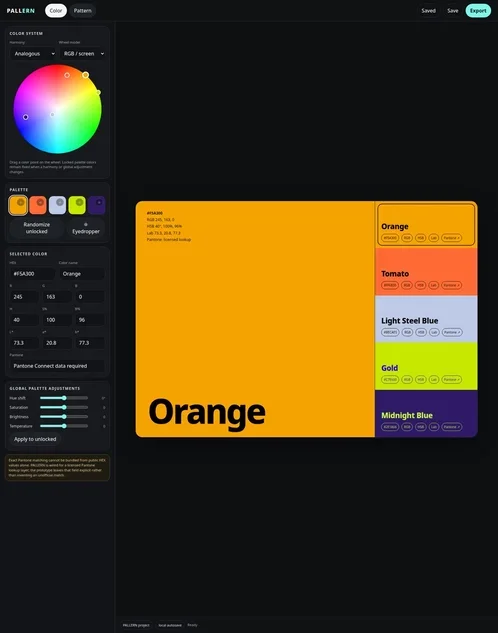
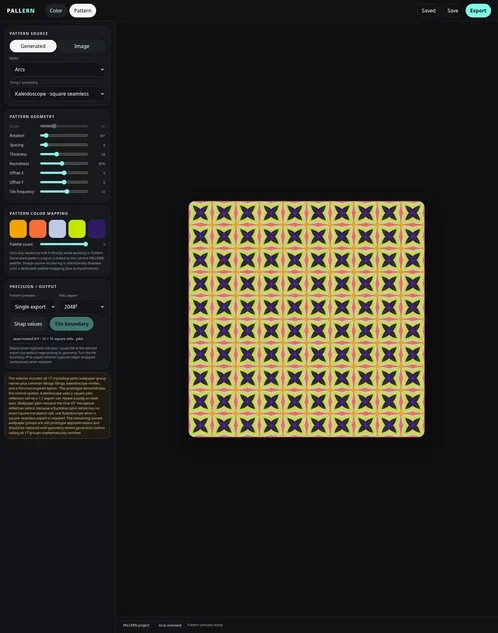


PALLERN
A browser-based palette and seamless-pattern tool for anyone who works in color and pattern: designers, illustrators, and surface artists.
Spec and direction · Figma Make · v0.6 to v0.7
- SVG / PNG / CSS / JSON export
- 219/219 self-tests
- 32/32 stress tests
I was tired of jumping between one tool for color and another for patterns. PALLERN puts them in one place: change the palette and the pattern changes with it, no restarting. The kaleidoscope math was the hardest part to get right. If the geometry is off, the output breaks.
Previous version · v0.6
Three problem areas: square repeats, snap values, the color wheel.
v0.6 problems
- Square repeats broke along one axis where the tiles met
- Snap values rounded like a normal slider, so cells could land between pixels
- The color wheel came back blank after switching tabs, and its edge rendered pixelated
Resolved · v0.7
All three fixed in v0.7. Square-repeat edge jump measured 18.18x down to 0.16x.
v0.7 fixes
- Square repeats rebuilt on a p4m square reflection cell
- Snapping is seam-aware and tied to the export size, so every cell lands on whole pixels
- The color wheel redraws on tab return
- Wheel edge defined by CSS clipping at full device resolution


Source: canon 3.1 (Layout Grid Canon, Phase 1).
Format: 210 x 297 mm.
Margins (inner / top / outer / bottom): 23.3333 / 33 / 46.6667 / 66 mm.
Live area: x 23.3333, y 33, 140 x 198 mm.
Guideline x positions: 0, 23.3333, 163.3333, 210 mm.
Guideline y positions: 0, 33, 231, 297 mm.
Layout Grid Tool
A grid generator built from the canonical layout systems: pick a system and a format, get the grid as exact numbers, then export the same grid to Canva, Photoshop, Figma, and Framer.
Spec and direction · Nov 12, 2026 · v1.1
- 18 canonical systems, each generated from its source
- 1,017 of 1,026 combinations build · 9 explained · 0 silent failures
- 27 of 27 audit findings corrected · confirmation re-audit clean
- Exports: layered SVG, PNG overlay, Photoshop JSX, Figma, Framer, agent pack
Grid systems were a fundamentals gap for me. I concept layouts by eye and had no formal grounding in the canonical constructions, or a reliable way to carry one grid, exactly, into Canva, Photoshop, Figma, and Framer at once. So I specced a tool: research the canon first, build a core where every grid is one exact spec object, and render that spec into each app's format, so the outputs cannot disagree.
Problem
Layouts concepted by eye, the canonical systems unlearned, and every grid redrawn by hand when it moved between apps.
Problem details
- The systems to learn: Müller-Brockmann, Gerstner, Tschichold, Van de Graaf
- Every grid had to stay a faithful, citable construction of its named source
Method
Canon first, numbers before lines: the systems researched at source, then built as generators that each return one exact spec.
Method details
- 18 named systems with constructions, format and ratio standards, and citations
- Published worked examples recomputed and set as known-answer tests: Gerstner's U=58 table, Van de Graaf on A4, Lupton's 42-line baseline
- Every exported line position is recomputed from the spec at export time
Audit
An independent stress-test audit of the research and the core returned 27 findings. Every one was corrected or struck, and a confirmation re-audit passed before any exporter work began.
Audit details
- 27 findings: 6 errors, 3 unsupported, 11 gaps, 7 nits
- A Tschichold Fig. 4 preset enforced an exact golden ratio the source warns against; it was rebuilt on the source's stated proportions
- Tests that could not fail, drawn from the same reading as the code, were rebuilt; the suite grew from 26 to 52 checks
- An unsourced Ruder claim was removed; Material 3 values were labeled provisional
- Confirmation re-audit: 27 of 27 addressed; exporters authorized
Result
A working tool, shipped in one day, that doubles as the reference the gap is learned from: every grid on screen carries its source and construction.
Result details
- One self-contained HTML file: opens in any browser, works offline, no install
- The JavaScript port matches the Python core: 33 fixtures numerically identical, 72 exported files byte-identical
- v1.1 acceptance sweep: 18 systems × 57 format contexts, every combination run; the 9 refusals are explanations in words, with 0 raw error text in any of them
- Exports from the one spec: layered SVG for Canva, a Photoshop script that creates the document and adds native guides
- Figma values in the Plugin API's own shape, Framer sheets recomputed per breakpoint, and agent packs (spec JSON, SVG, PNG, spec sheet) for handing a grid to an AI agent
A Kinesis of Aesthetes
The Space Between: Hive Mind · Colonna Contemporary Gallery, Wayne, PA · November 2024
A digital original and its hand-painted counterpart, made as a pair for a group show about bridging the digital and physical art worlds.
The start
In September 2024, SuperRare invited me into The Space Between: Hive Mind, a ten-artist group show at Colonna Contemporary Gallery, presented with Hildabroom. The brief was a theme: bridging the gap between the digital and physical art worlds, answered in a physical piece, a digital piece, or both. My answer was both, in one work. The subject is the artist community itself, a collective in fluid, intentional motion, each artist’s energy feeding the whole. The composition opened in AI-assisted concept studies built on my own earlier artwork, then settled in a layered Photoshop file.

The decisions
Resolve it on screen first
The composition gets settled in a layered Photoshop file, where an arrangement can be tested and undone before paint makes it permanent.
Paint it twice
The work exists in full twice: a finished digital original, then the same composition painted by hand on canvas, 24 by 36 inches. The digital pass works out every passage before the canvas pass commits it.
Keep the fields, model the hands
Modeling is reserved for the hands, built up in paint layer by layer.

The finish


Two weeks built the digital original. The painting took eighteen days and 144 hours of brushwork. The pair shipped to Pennsylvania by November 1, and the painting hung at Colonna for the opening on November 8, 2024.
Try it on your phone
Scan to open this page on your phone. The holographic foil responds to your phone's tilt.
Open to remote design roles and select client projects.

Contemporary Fine Artist
Creative Technologist · Builder